|
"Human Supervision and Control in Engineering and Music" |
| Workshop | Orchestra Concert | Ensemble Concert | About us |
| About
Program Participants Proceedings FAQ Version:
1.3
|
How is a Symphony Started by the Orchestra?Shin Maruyama Key words: orchestral performance, interpersonal coordination, coherent margin of relative timing AbstractIn this empirical research, the author used the video data of actual rehearsals by a professional orchestra and focused on the interpersonal relation between conductor and concertmaster. The main result suggested that there might be a coherent margin of relative timing between conductorís body movement and concertmasterís bowing action to generate their artistic performance. MissionThe purpose of this pilot research is to describe the generative process of the orchestral performance in terms of interpersonal coordination between the conductorís body movements and playerís actions and to investigate empirically how the conductor and player start their performance. Data and AnalysisThe observational video data was used which recorded the process of all rehearsals and recording sessions (for 3 days) of the professional chamber orchestra, Tokyo Mozart Players, produced and conducted by the well-known Japanese conductor, Rysuke NUMAJIRI, with the 5th symphony composed by L.V. Beethoven. This popular symphonyís opening theme of the 1st movement may be called ëa touch stoneí to judge whether the ensemble between a conductor and orchestra is coordinated well or not so well because of the difficulty in playing due to itís unique rhythmic structure (Fig.1). Therefore, as a primary analysis, the author has focused on the serial changing process of interactive relations of the conductorís body movements and the concertmasterís playing at that opening theme performance.
fig.1 : The Opening Theme of Beethovenís 5th Symphony (1808)
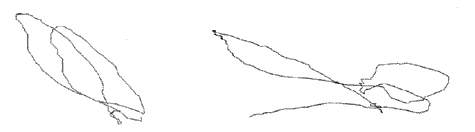
MethodBy counting time code of video recorded in high-speed ratio (120Hz:Victor GR-DVL-700), the following analytic points were measured on each rehearsal and the recording session: (1) The form of the conductorís hand stroke movement / (2) The relative timings between the conductorís directive action for sound utterance which was ordinarily done by right hand and the concertmasterís bowing start points (actual sound utterance). / (3) The induction timing of the concertmasterís bowing. ResultsThe opening theme performances were persistently repeated: 7 trials (the 1st day), 6 trials (the 2nd day) and 11trials (the recording session). All statistical analysis was done by nonparametric test. The Structure of Conductorís Hand StrokeThat conductor conducted with a baton on the 1st and 2nd day of rehearsals but on the recording session, he didn't use a baton through all trials on that day. The forms of conductorís hand stroke were changeful and showed various styles. Fig.2-Left shows the ëverticalí stroke with a baton that was observed on the 1st and 2nd day and Fig.2- Right shows the ëhorizontalí one without a baton that was observed on recording session only. These figures were made by tracing the positional change of the back of conductorís right hand.
fig.2 Left and Right : The Variations of Conductorís Right Hand Strokes
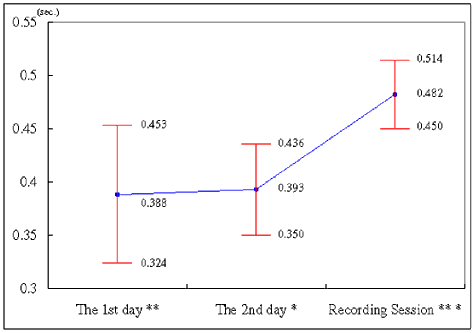
The Progressive Change of The Eighth Rest ValuesThe relative timing between the end point of the conductor's hand stroke and the concertmasterís bowing start (for playing the 1st tone showed as ë1í in Fig.1) indicates the length (= value) of an eighth rest which is corresponded to ë0í in Fig.1. The average of the eighth rest length on each day was different significantly (showed in Fig 3). The conductor's hand stroke was measured by the positional change of his right hand's back whether he conducted with or without a baton. Because it seemed that, in the case of this conductor, the track (position or direction) of a baton was approximately correspondence to the position of his right hand.
On the other side, there is a tendency that the variances in time lags
between the conductorís stroke end point and the concertmasterís induction
timing to start bowing gradually got smaller as rehearsals going. On the
1st and 2nd day, that time lags seemed to be fluctuating. However, only
on the recording session, that time lags were coherent in a certain range.
DiscussionThough the forms of conductorís hand strokes showed unique variations, the relative timings between the conductor's movement and the concertmaster's action shifted from some fluctuations to a certain range delays. According to these results, it is supposed that the 1st and 2nd day of rehearsals were the process that both the conductor and the concertmaster explored each other the coordinative timing to start that symphony. Thus, the larger delay (= the longer values of the eighth rests) observed persistently on the recording session might be a meaningful margin to generate the specific and artistic performance of that symphonyís opening theme as a goal of their mutual exploration. Therefore, the coherent margin of relative timing between the conductor's and the concertmaster's actions may imply or embody some artistic information that was explored by and shared with the conductor and the concertmaster to guide the interpersonal coordination as the orchestral performance. An additional notesThis research was supported by Grant-in-Aid for Scientific Research of Japan Society for Promotion of Science (grant no.09620). I express my acknowledgment to Mr. Koji HAYASHI (The University of Tokyo) for his help with the making figures. |